 Welcome to India Market Access
Policy Making at SEBI
Overview
SEBI is committed to a transparent, consultative, and structured policy-making process for India’s securities market. Our approach ensures that every regulation is well-informed, widely discussed, and consistently implemented.
How SEBI Formulates Policies:
A Step-wise Overview
SEBI’s policy-making journey begins with brainstorming and public consultation, followed by expert review and Board approval. Each stage is designed to ensure transparency, participation, and regulatory clarity. The process is as follows:
1. Ideation & Internal Discussions
- Policy formulation starts with internal brainstorming and deliberations within focused Working Groups.
2. Public Consultation
- Draft consultation papers are published on SEBI’s website, inviting feedback from the public, industry experts, and stakeholders.
3. Policy Advisory Committees
- Advisory Committees Committees like the FPI
Advisory Committee bring
specialized expertise to the table. review the proposals and public comments in detail.
4. Board Deliberation & Approval
- A detailed Memorandum, Board Memoranda are
comprehensive documents
proposing regulatory changes.explaining the regulatory intent and stakeholder feedback, is presented to the SEBI Board.
5. Transparency in Decision-Making
- All Board Memoranda and meeting minutes are published online for public access.
Visit SEBI’s website for
recent policy decisions.
SEBI’s Three-Tier Policy Framework
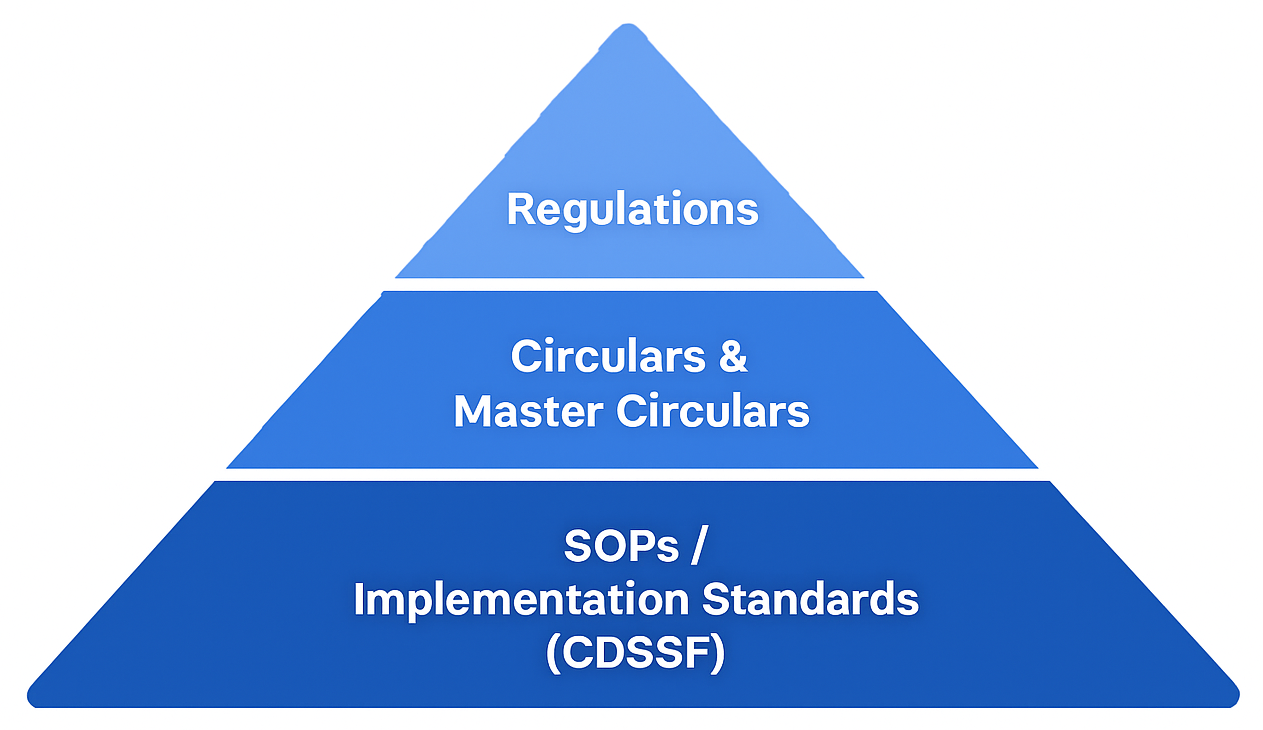
After policy approval, SEBI follows a three-tier framework for implementation. This structure ensures that every rule—from broad principles to operational details—is communicated and applied consistently across the securities market.
Tier I: Regulations
e.g., SEBI (FPI) “FPI” = Foreign Portfolio InvestorsRegulations, SEBI (Custodian) Regulations
These form the broad legal framework
Tier II: Circulars & Master Circular
Periodic circulars detail operational aspects. An annual Master Circular, Master Circulars are comprehensive documents summarizing all relevant circulars issued during the year.consolidates all updates for easy reference.
Tier III: Implementation Standards (SOPs)
The Custodians and Depositories Standards Setting Forum (CDSSF), CDSSF is a forum where
custodians, depositories, and SEBI
collaborate on granular
implementation standards. in collaboration with SEBI, develops detailed SOPs (Standard Operating Procedures) for effective, consistent implementation.These form the broad legal framework
Why This Matters
SEBI’s process ensures that:
- Multiple viewpoints are considered
- Market participants clearly understand and implement regulations
- The regulatory intent is always transparent and accessible